The Posthumous Memoirs of Brás Cubas - Machado de Assis
- December 17, 2025
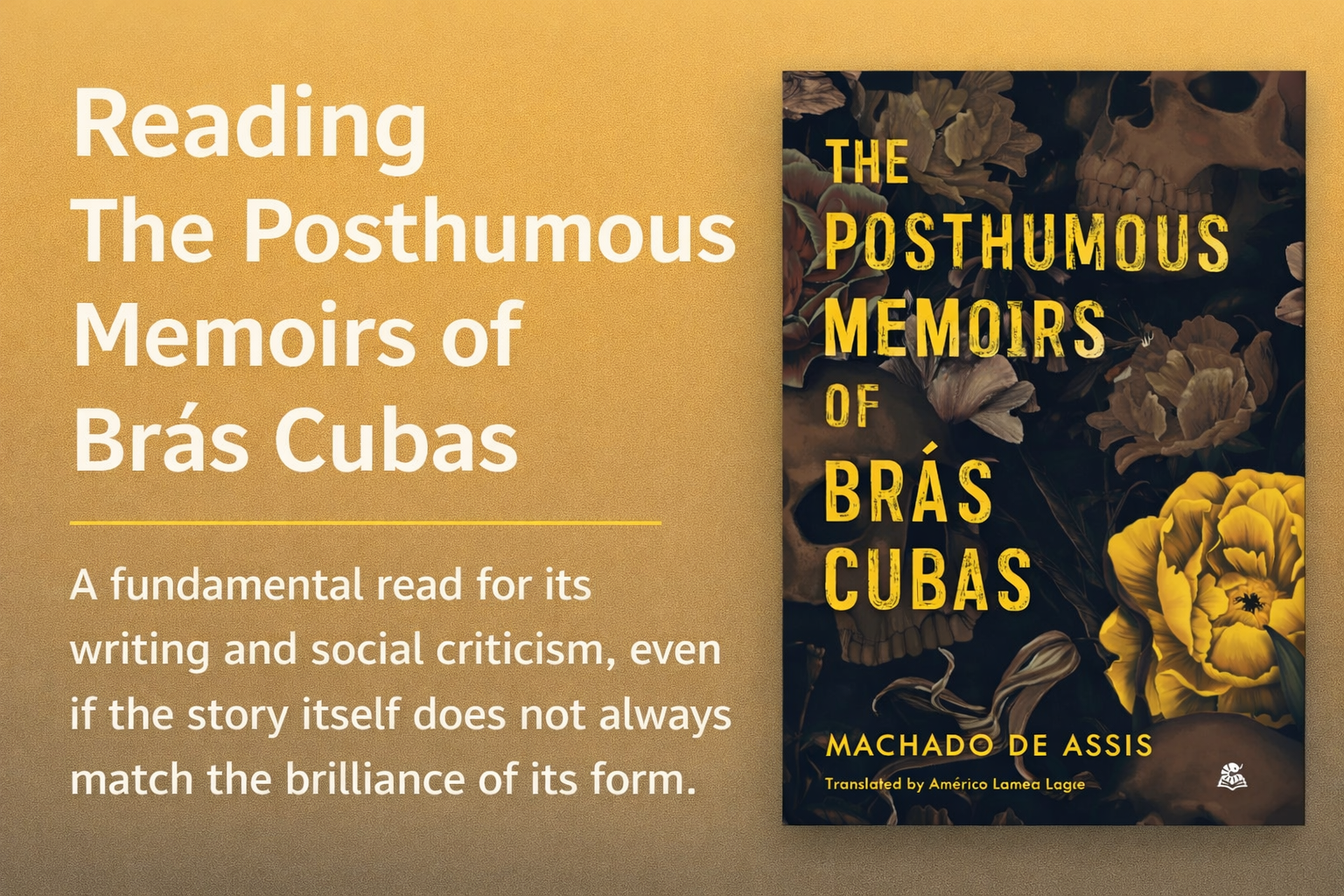
The Posthumous Memoirs of Brás Cubas is one of those books whose importance is unquestionable. Machado de Assis narrative innovation, the quality of his writing, and his subtle, sharp irony remain strikingly relevant more than a century later. Reading Brás Cubas is coming face to face with an author who deeply understands human behavior, social games, vanity, and hypocrisy disguised as morality.
The premise itself is brilliant. Brás Cubas decides to write his memoirs after his death, when he no longer needs to please anyone and can, at least in theory, tell the truth more freely. This starting point opens space for a narrative filled with direct addresses to the reader, interruptions, digressions, and a humor that is often carefully crafted. There are passages that, on their own, already justify reading the book.
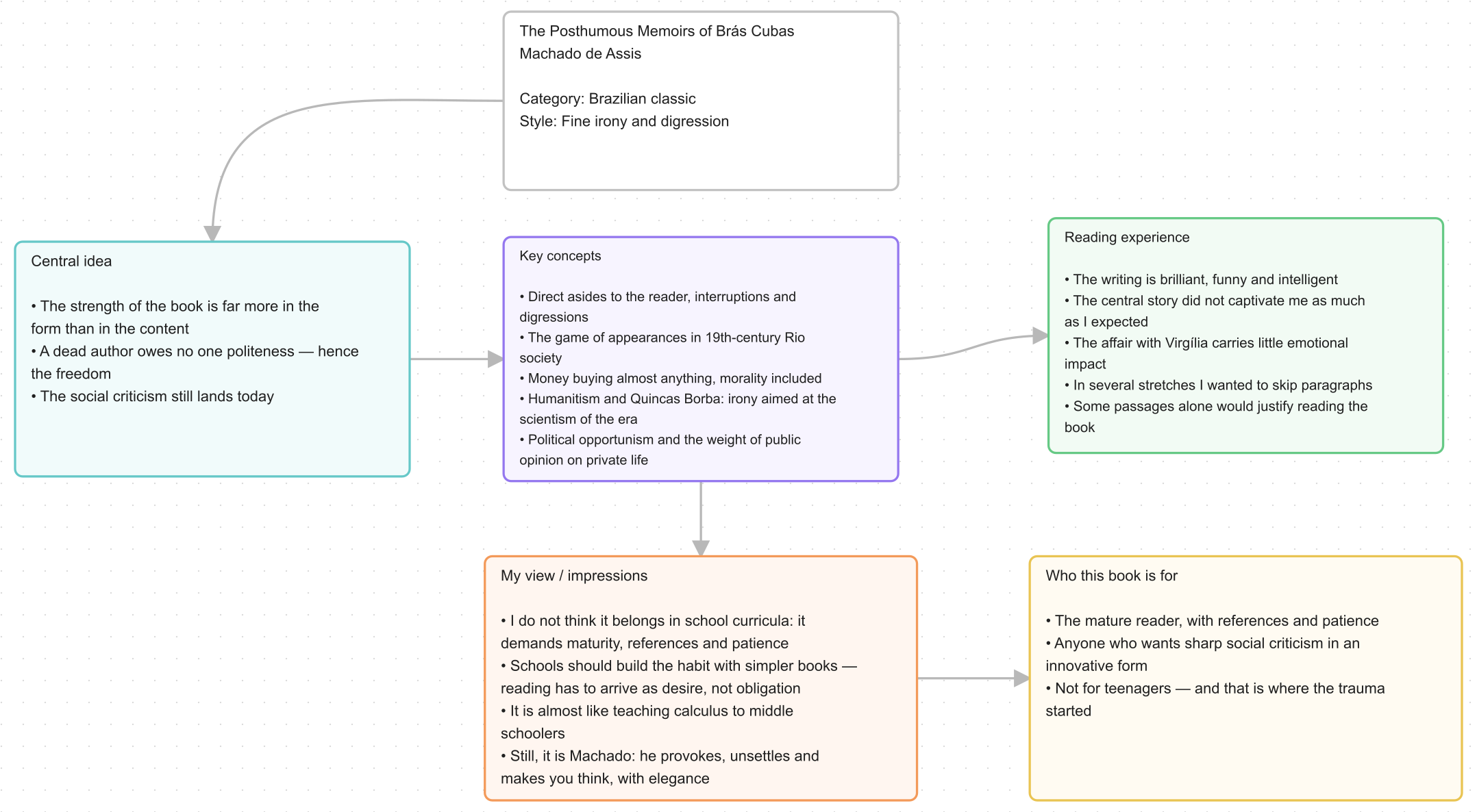
Beyond the story itself, what stood out to me the most was the critique of nineteenth-century Rio de Janeiro society. Machado exposes the world of appearances, the weight of public opinion on private life, political opportunism, and the idea that money can buy almost everything, including morality. The creation of Humanitism, embodied by Quincas Borba, works as a sharp irony aimed at the scientific theories of the time, especially social interpretations of Darwin’s theory of evolution, here transformed into a justification for the law of the strongest.
Even so, despite deeply admiring the writing and the intelligence behind the book, the central story did not engage me as much as I had expected. I gradually built the expectation of a more intense, more compelling protagonist. At first, Brás Cubas appears as a typical nineteenth-century bon vivant: wealthy, carefree, and somewhat cynical. But as the narrative unfolds, what remains is the feeling of a relatively predictable life and, at times, even a slightly dull one.
The romance between Brás Cubas and Virgília, which occupies a significant portion of the book, did not strike me as particularly interesting. The relationship exists, but it does not evolve in a way that creates strong emotional impact. In several moments, I admit I felt the urge to skim through a few paragraphs.
In the end, I was left with the impression that the true strength of The Posthumous Memoirs of Brás Cubas lies much more in its form than in its content. The writing is brilliant, playful, and intelligent. The social criticism is sharp and still resonates today. The story itself, however, did not leave the mark I had anticipated.
I also do not believe this is a book that should be taught in schools. The reading demands maturity, cultural background, and patience. The language carries structures and expressions that are no longer part of everyday usage, which makes comprehension even harder for very young readers.
Schools should encourage the habit of reading with simpler books, texts that are more direct and capable of awakening curiosity and pleasure. Reading needs to come first as desire, not as obligation. Forcing dense classics too early often produces the opposite effect and pushes readers away.
As much as I see this work in a very positive light, it is not for every reader, let alone for teenagers. When I was in school, The Posthumous Memoirs of Brás Cubas was mandatory reading in literature classes, and the “trauma” still lingers for many people. It is almost like trying to teach differential and integral calculus to elementary school students: some content requires maturity to be properly absorbed. This book is one of those cases.
Still, it is Machado de Assis. And that alone is reason enough to read him, at the right time. Even when he does not fully captivate us, he provokes, unsettles, and makes us think. And very few authors do that with such elegance and irony.